THE AMAZING STEPHANUS GREEK NEW TESTAMENT OF 1550!
Introduction
In this article we present an
amazing
mathematical study of the Stephanus Greek New Testament versus the
Hort and Westcott Greek New Testament. It shows a great many
mathematical
relations that are highly superior in the Stephanus Greek New
Testament. It
will even show the Stephanus Greek New Testament is "perfect," in our
expert opinion (Engineering degree with associated math, and 50+
years of studying the Bible for a total of about 7800+ hours). In
fact, the mathematical relationships we will present are so astronomically improbable
as to assure us that the Stephanus Greek New Testament is the very Word
of God, as penned by the Apostles! It
is not only that there are so many mathematical relationships (75+ so far), but also
the kinds of mathematical relationships that leads one to
believe that only God could have inspired the text that Stephanus
managed to get perfectly right in his GNT. The fact is that
we had to use several spreadsheets to do the math for us to uncover the
amazing improbable mathematical relationships. Stephanus and the
original authors did not have spreadsheets for summations and CRC
calculations. Thus we feel we have the
original text of the original authors in the Stephanus GNT, but this is not in
the Hort and Westcott GNT, as you will see.
Definitions
For this article,
we are providing the following terminology:
- GNT = Greek New Testament
- STGNT = Stephanus Greek New
Testament, text format, latinized Greek letters, entire NT on one line, raw, no white space, no notation of any kind.
- HWGNT = Hort and Westcott Greek
New Testament (the basis for 98% of modern versions)
- GNV
= Greek Numerical Value = the value of a Greek word based on the summation of the numerical
value assigned to each letter by the Greek numbering system. It is
also the GNV of individual letters too. (Alpha =1, Beta = 2, etc)
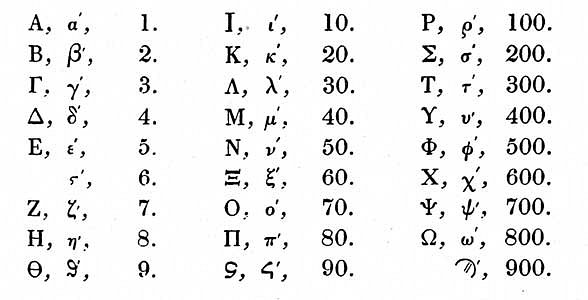
(See Figure 1, below.)
- a "low-order
factor" is an integer that divides exactly into an integer of interest,
and is less than 1/2 of the integer of interest
- a "high-order factor" is an integer that divides exactly into an integer of interest, and is greater than 1/2 of the integer(s)
- a "factor" is an integer that divides exactly into an integer of interest
- in our representation of the
spellings of Greek words we use “Latinized” letters accepted by most
- digital
root = summation of all the numbers in a longer number; for example 796
= 7+9+6 = 22 (2-digit root) and 2+2 = 4 (1-digit root).
Major Findings
By
examining the Stephanus GNT for mathematical relationships, we found
(thus far) that the Stephanus Greek New Testament has many fairly
independent coincidental mathematical improbabilities. Conservatively, the odds
against these relationships are 1 in 108 x 10135 , or 1
chance in 108,097,183,049,302,000,000,000,000,000,000,000,000,000,000,000,000,000,000,000,000,000,000,000,000,000,000,000,000,000,000,000,000,000,000,
000,000,000,000,000,000,000,000,000,000,000 or 1
chance in 108 followed by 135 zeros !!!!!!!!! Therefore
it is by
these odds we are compelled to accept the Stephanus GNT as the very
Word of
God, as it was written 2000 years ago. Some that read this will
scoff, and we understand why: liberal theological thought. The above odds are computed from the products of the odds in Table 1 and Table 3, below. When we did the same kind of comparisons on the HWGNT, we only got an order of magnitude of 1015th . This is essentially down in the "noise," that is, it is just simple coincidence, not astronomical improbability. The above odds point out two things. - Bibles not totally derived from STGNT probably should not be used. This includes translations based on HWGNT, in part or in whole, or its derivatives UBS, NA, SBL or The GNT, which are unfaithful based on our mathematical findings. (See list of these for English translations at HW_TR versions.)
- Those
who have not been saved yet should see these odds, recognize the truth, acknowledge
they are sinners, believe Jesus died for their sins, repent and
surrender to the Lord to be saved, because this proves God is behind
the New Testament, in particular, the Stephanus GNT, and likely, faithfully derived translations, so God is alive and real!
The above facts, plus those facts shown in Possessing God's Word
show that most all modern translations are suspect at best, and heresy
at worst. Why would I want a translation that is not the best? You be the judge of what is best for you.
Now we present a summary of proofs' tables, followed by our detailed proofs.
Table 1 - Summary of Superior Stephanus Greek New Testament over Hort and Westcott One may refer to Table 2 for most of the numbers in the table that follows, which are the basic statistics of the STGNT.
| REF | ITEM | STGNT | HWGNT | STGNT ODDS | | N.1.1 | every digit in the total character count (692,370) is a low-order factor of that count (HWGNT = 675,828) | yes | no | 1:1845 | | N.1.2 | large number of factors in NT character count over HWGNT | 72 ! | 36 | 1:9 | | N.1.3 | 2-digit digital root of 692,370 characters = 27 = # books in NT (HW = 675,528) | n2 = 27 | n2 = 33 | 1:54 | | N.1.4 | 3 pairs of digits in 692370 have sums = 9, which is required to get 9*3=27 books | yes | no | 1:1000 | | N.2.1 | 6 times the set of factors as HW | 24 ! | 4 | 1:27 | | N.2.2 | two-digit digital root of 140,526 words = 18 = # of books explicitly written to churches (HW = 136,702) | n2=18 | n2=19 | 1:20 | | N.3.1 | 9 times the set of factors as HW | 36 ! | 4 | 1:41 | | N.3.2 | two digit digital root of 7956 verses = 27 = # of books in the NT (HW = 7939) | n2 = 27 | n2=28 | 1:67 | | N.4.1 | The single-digit digital root for the sum of the number of characters, words and
verses = 27 (9 + 9 + 9) (HW = 6 + 1 + 1 = 8) | n2=27 | n2=08 | 1:16
| | N.5.1 | The
Stephanus GNT in an assumed chronological order, per Table 2 and Table
3 yields significant probability that this order is the chronological
order.
| yes | no | 1:240x1047 | | P.5.1 | special prime 41, low-order factor, 10+ coincidences in Bible | yes | no | 1:200 | | P.5.2 | 7 low-order factors of the nature of binaries and binaries times prime 41 | yes | no | 1:556 | | F.1.1 | When
the letters q, e, o and V in the name of God (qeoV) are counted in the
entire STGNV and multiplied by their respective GNVs, each has a digital root =9. No other letters have such a relationship. | yes | none | 1:729 | | F.1.2 | “God” as “qeoV” (GNV = 90) and “qeouV” (GNV = 490) are both low-order factors of the number of characters of the
STGNT. [odds for both are about 1:184] | yes | no | 1:184 | | F.1.3 | 334 Greek unique words having GNVs that are factors of NT character count | 334 ! | 54 | 1:9 | | F.1.4 | Stigma substitution for Sigma has to be exact count for the total STGNT GNV to come out right. | yes | no | 1:18 | | F.1.5 | the
number of Stigmas (25,728) and number of Sigmas (26,781) both have a
2-digit digital root = 24, and a 1-digit of 6, and when added
together have a 1-digit digital root = 3, the number of the trinity. | yes | no | 1:450 | | F.1.6 | Alpha
and Omega, a trait God gives to Himself, has a sum of occurrences of
these two letters with a 1-digit digital root = 3 (trinity), and
when this is subtracted from this sum, have a 2-digit sum of 27 = #
books in NT | yes | no | 1:60 | | P.6.1 | NT GNV (75,888,704) tells the central theme of NT: "Jesus purchased (his) own" (based on words with GNVs of 75 and 888 and 704) | yes | no | 1:26,341 | | P.6.2 | NT GNV + chapter, verses, words and character counts = 76,729,816 and tells us in Greek " "all-are-able, all-repent, completely" (base on words with GNVs of 76 and 729 and 816) | yes | no | 1:26,341 | | P.6.3 | The above count (76,729,816) has a 1-digit digital root = 1 (God, unity) | yes | no | 1:9 | | P.6.4 | The STGNV has 28 factors. The 1-digit digital root = 1 (God, unity) | yes | no | 1:9 | | M.1.1 | Johannes Comma has total GNV of 9936, yields 2-digit digital root = 27 books of NT, so it belongs there! | yes | no | 1:270 | | M.1.2 | only
three Greek words have GNV = 999, and each summed = 27 books of Bible,
and three is the number for God as well. The three words based on their
GNVs of 999 form the sentence: "Apostles-spoken-word published and finished" | yes | no | not calculated | | M.1.3 | Greek spelling for "David", dabid (GNV=21) or dauid (419)?
Which has same digital root that represents God (3)?
So "dabid" is in accord with God. | dabid=3 | dauid=5 | not calculated | | TOTAL ODDS FOR STEPHANUS GREEK NEW TESTAMENT IN THIS TABLE | | | 1: 3.2x1039 |
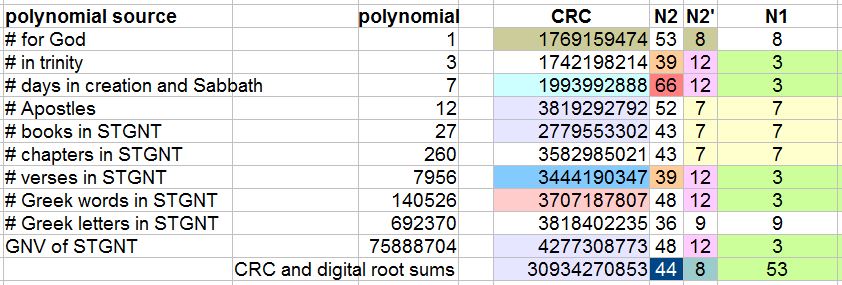
For more details for the above table refer to Reference 1. Table 2 -STGNT Chronological Book Order CRC-32 Results' References
NOTES:
- This
table uses a file containing the books of the STGNT in a supposed
chronological order, wherein, only the Latinized representation of the
Greek letters are used, and nothing else (no book names, verses, or
even white spaces). The entire STGNT is on one line of text.
- Column 1 is the polynomial value input into the CRC-32 program used for this file
- Column 4 is the resultant CRC for each respective polynomial used
- N2 = initial 2-digit digital root
- N2' = secondary digital root (1 or 2 digit)
- N1 = final 1-digit digital root
- The colors are reference only.
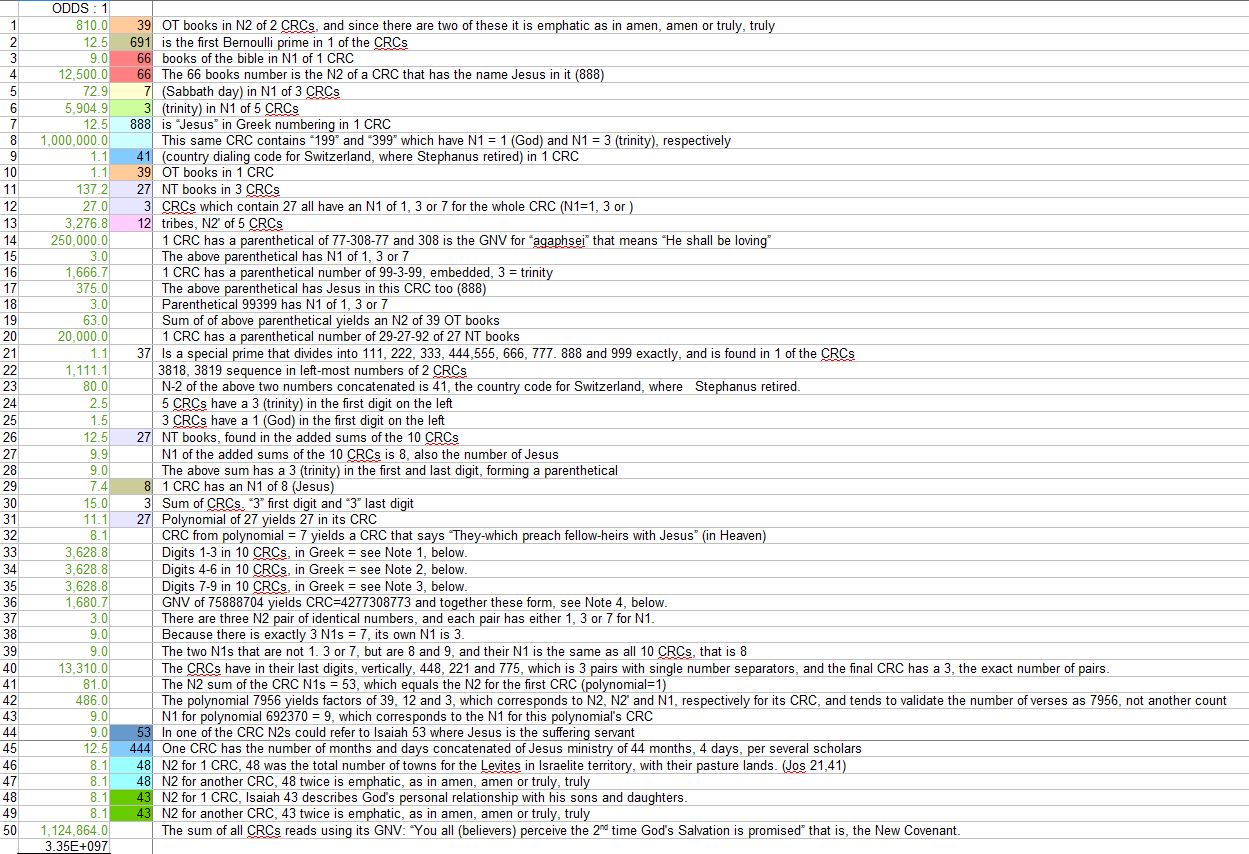
Table 3 -STGNT Chronological Book Order CRC-32 Coincidences Odds' Calculations
This table shows the individual odds' calculations we made based on various relationships in Table 2, above. (The colors are reference only.)
NOTES:
- Digits
1-3, vertically in 10 CRCs, in Greek = “From what-place is Jesus
lifting-off of sinners the penalties-of-sins? Seek-from-there a
living righteousness.”
- Digits 4-6, vertically
in 10 CRCs, in Greek = “Barabbas, freed and given to the barbarians,
opened-up-immediately (God's) love, conveying peace to the saddened
ones.”
- Digits 7-9, vertically
in 10 CRCs, in Greek = “We now preach a view, which is aimed at you, to
repent, especially because of the atonement made by (Christ's) dying,
blotting out all (sin) that a sinner bears.
- GNV
of 75888704 yields CRC=4277308773 and together these form “Jesus
purchased his own” “and (he) speaks to and loves the righteous ones”
Reference 1 - Details for Table 1, at top.
Here are
the “mathematics” of the STGNT that Table 1 is is based on. There
are reference numbers in braces {x} that refer back to those in Table 1.
Total number of Greek
characters in STGNT: 692,370
{N.1.1} each single digit in this
number (6,9,2,3&7) is a low-order factor of the whole (all single numbers divide exactly
into 692,370, with no remainders) [odds 1:84]
{N.1.2} including
the digits above, the total number of integers that are factors of the number 692,370 is 72, which is a fairly
large number of factors for this many characters [odds, about 1:225 for 6-digit, random number]
{N.1.3} the two-digit digital root = 27 (6+9+2+3+7+0=27), which equals the number of books
in the New Testament! [odds 1:81, conservatively]
Total number of words in STGNT: 140,526
{N.2.1} there are 13,632 words with GNVs that equal 24 factors of 140,526 words, a fairly
large number of factors [odds 1:400, conservatively]
{N.2.2} the two-digit digital root of 140,526 words = 18 (1+4+0+5+2+6=18), which equals the number of books in
the New Testament that were written explicitly to churches (the
other 9 were historical or written to persons) [odds 1:81]
Total number of verses in
STGNT: 7956
{N.3.1} there
are many words with GNVs that equal 34 low-order factors out of a
possible 36 factors for the number 7956, a fairly large number of factors [odds 1:250]
{N.3.2} the two-digit digital root = 27 (7+9+5+6=27), which equals the number of books in
the New Testament [odds 1:54]
{N.4.1} The single-digit digital root for the sum of the number of characters, words and
verses = 9 in each category, and 9 + 9 + 9 = 27, the number of
books in the New Testament. [odds 1:81] {N.5.1} through {N.5.9}
A
Cyclic Redundancy Check (CRC), detects not only added/missing verses,
words or characters, but things that are out of order. For
testing purposes, we put the Stephanus GNT is a supposed chronological
order than came from a source who used hundreds of scholars and
consensus using an averaging system to figure out what is the most
likely chronological order.
What
we did was to apply a CRC check to this chronological order using 10
different polynomials (Table 2 and Table 3, both below). What we found was that the
coincidences were extraordinary in terms of a huge probability.
The summed GNV of the
692,370 characters based on their assigned Greek numerical values is
75,888,704
The
prime number 41, which is a low-order factor in the total GNV of
the STGNT (75,888,704), also has some special coincidences of its own:
- 41
generations are listed from Abraham to Jesus, in Matthew 1 (There
are not 42 generations, since there is a twice listed generation in verse 17.)
- Jesus'
big temptation from the devil, after 40 days without food, came on
day 41
- {P.5.2} The
author Stephanus ended his career in Switzerland (as a reformer,
not a Catholic), which amazingly today, uses the international
dialing code of 41 ! [odds 1:200]
- note that the other odds (above), are not being counted, just to be conservative, even though they are amazing!
In relation to the total GNV of the entire STGNT (75,888,704): - the
number "888," is the GNV of "ihsous" (Jesus - nominative), and in
the middle of the total GNV of the STGNT is the number "888". This number does not appear in the total GNV of the HWGNT (3,594,544)!
- the
"704" in this number includes words with this GNV meaning
"they-have-pierced-him," "ye are purchased" (with a price) and
"they-shall-be-changed" (born again).
- {P.6.1} the
"75" in this number includes the word "own" and together we can form a
sort of sentence "own (object - acc) Jesus (nom) purchased" or in
English SVO order "Jesus purchased (his) own (with his blood)" or others like
"Jesus changed (his) own (redeemed)," [computed
odds are 1:26,341 for all three words to be found that represent
the entire theme of the NT, that is the redemption of His own via His
blood. This is very conservative odds.]
- the
HWGNT has a GNV of 73,594,544, and a search of the same kind as above
for STGNT reveals only a mixture of words, with no special words or
messages in the HWGNT total GNV
- the GNV sum of all the words that are low-order factors of 75,888,704 is 1,673,191 which has a digital root = 1 ("God", unity)
- the
sum of all of the low-order factors of 16,731,191 is 2443, and
minus the unity factor (1) is 2442 with a digital root =3 the number of the trinity.
- the
number 41 is the reverse order of 14, the number of all low-order factors listed
previously that divide into the total GNV of the STGNT, 75,888,704
- {P.6.2} When we add up the number of chapters, verses, words, characters and the total GNV for the STGNT we get 76,729,816.
This number has a digital root =1, and has its own "story" that
reads "all-are-able, all-repent, completely" which when tied to the
story above, really is amazing! (BTW, this story means a one time repentance saves forever.) [Including the odds of the story and the digital root odds, we are looking at 1:26,342 odds. This is very conservative odds.]
- {P.6.3} The above sum (7,729,816) has a digital root = 1 ("God", unity) [The odds of this are 1:9]
- {P.6.4} The STGNV (75,888,704) has 28 factors. The digital root = 1 ("God", unity) . [The odds of this are 1:9]
- note that the other odds (above), are not being counted, just to be conservative, though they are amazing!
The
name of God in Greek as “qeoV” (nominative) and “qeouV”
(accusative) have a GNV of 90 and 490, respectively,
and those two numbers are low-order factors of the 692,370 characters in the STGNT:
{F.1.1} with
respect to each letter in “qeoV," when each GNV of each letter is
multiplied by the number of occurrences of that letter in the NT, each
has the same digital root = 9. No other letters in the NT,
when
treated this way, equals 9 [odds, conservatively
1:729] - {F.1.2} “God”
in the Greek as “qeoV” (nominative, GNV = 90) and “qeouV” (accusative,
GNV = 490) are both low-order factors of the number of characters of the
NT. [odds for both are about 1:184]
- {F.1.3} Including
the above two words, there are 334 unique words from the STGNT with GNVs which are low-order factors of the total number of
characters, and from digital root, the number 334 = 1, ("God", unity) that coincidentally shows a 334 words' GNV to
character count relationship. [odds 1:9]
{F.1.4} the
Greek letter Stigma (represented
by “V”), used above for “qeoV,” has to have the correct
quantity in the NT in order to yield a total GNV that has a digital root = 9, for the example above. Stigma
is an alternate for Sigma btw, and Stigma ("V") is used only at the end of words, but Sigma
is used elsewhere,
and this is inconsistent in many Greek NT texts, but not in the
Stephanus
Greek New Testament. Not all Greek texts agree on the use of Stigma
versus Sigma, but Stephanus gets it right in order to make the numbers
come out right, coincidentally, since Stigma is not the same GNV
as Sigma [odds 1:18, conservatively] - {F.1.5} the
number of Stigmas (25,728) and number of Sigmas (26,781) both have a
2-digit digital root = 24, and a 1-digit of 6, and when added
together have a 1-digit digital root = 3, the number the
trinity.
(Note: Stigma is a replacement for Sigma under specific grammar rules,
but otherwise is basically the same as the English letter "s".) [odds 1:50 for both having same 2-digit sum] [odds for 1-digit sum of both = 3 (trinity) 1:9] [total odds 1:450]
- {F.1.6} in
Revelation 1:8, the Lord calls Himself the "Alpha and Omega". Alpha (a)
and Omega (w) are found in the STGNT 77,098 and 21,851 times,
respectively. The sum of these two numbers is 98,949 which has a digital root = 3, the number for God. [odds 1:9] And
when we remove the 8 & 4 from this number that are used to create
the digital root = 3, we are left with three 9s, whose sum is 27,
the number of books in the NT [odds 1: 27], but together the odds climb [odds 2-digit=2-digit 1:60]
- {M.1.1} What
about the Johannes Comma? These words are missing in some translations,
but are present in those faithful to STGNT. The Greek words in question
are "en tw ouranw o pathr o logos kai to agion pneuma kai outoi oi
treis en eisin kai treis eisin oi marturountes en th gh" and are found
in STGNT in 1 John 5:7b-8a. These words have a Greek summed GNV of
9936. If we add these single digits together, we get 27, the
number of books in the NT. Does that sound like these words belong in
the 27 books of the New Testament? It is a coincidence that the
challenged words total 27. [odds 1:270, since this is an external controversy and required 4 digits, not 3]
- {M.1.2} There
are exactly 3 Greek words in the STGNT with a GNV of 999, so all three have a
summed GNV of 27 (+9+9+9). These three words, when used in a sentence say:
"Apostles-spoke-the-word, became-published-everywhere,
so-it-was-fulfilled." (Published means copied and/or printed.) (Note that the odds are not being counted, just to be conservative, though this is amazing!.)
- {M.1.3} The
spelling in STGNT for "David" is "dabid" (GNV = 21) and in HWGNT, "dauid" (GNV = 419).
STGNT "dabid" (GNV = 21) has a digital root = 3, but HWGNT = 5. Three (3)
is the number for God. Five (5) is the number for a human hand number of digits, or several other things. (Note that the odds are not being counted, just to be conservative.)
{M.1.4} It
is true that any large publication, say a novel, can have mathematical
relationships too, but the New Testament has at least 8 writers, and
Stephanus, as a publisher had to chose from the variants what he
or his assistants deemed right. Those variants, had different words and
spellings and thus different GNVs and different CRC as well. Truly, the variance in NT
character count and total text GNV and CRC had a slim chance of becoming
the right number of characters, GNV and CRC that resulted in such a
large set of mathematical coincidences, as identified above, and there are far
more not identified.
ADDRESS YOUR QUESTIONS TO: info@millpark.org
The Count Counts
Note
that the version of the Stephanus Greek New Testament we used in
our study does not have
the verse, Revelation 22:21, and ours has the
corrected spellings per the 1551 edition as well. In fact, if
Revelation 22:21 were
counted, then instead of 7956 verses, there would be 7957. As it turns
out, 7956 has 34 factors, while 7957 has just 3! This adds to the
credence based on other evidence as well, that verse 22:21 does not
belong. (It appears after a little deeper study that this verse was
added as a benediction by another person instead of the author of
Revelation, and that it is a benediction that Paul used, so why would it be in John's Revelation?) Also,
there are 692,370 letters in STGNT without Revelation 22:21. This verse
has 48 Greek letters in it, and if added to 682,370 equals
692,418. So instead of 46 factors into 692,370 letters, there is
only 8 in 692,418 and the digit root value because unremarkable. The number of words in STGNT is 140,526,
but if we add Revelation 22:21, 11 more words would be added. So
instead of 17 factors in 140,526 words, there would only be 3 factors
in 140,537 words, and the digital root value becomes unremarkable. So when it comes to the rest of the New Testament, the count counts. Our
point: The number of characters, words and verses effects how important
the count is, and many resultant factors. The STGNT excels in
these 3 major
areas of low-order factors, as well as complete sets of factors. Change
things a bit, and the factors drop radically, and the digital roots become unremarkable
reducing odds to that of an ordinary novel, not the amazing Stephanus
Greek New Testament! There are a lot of missing and changed words in HWGNT, which
would alter the STGNT character, word and verse counts, and alter the total
GNV, such that the overwhelming perfection would be disturbed in STGNT,
even changing but a few things, or even just one letter! The Order Counts
It
has been well-established the approximate dates of the authorship of
each of the 27 books of the NT. Today, however, most all versions
are in today's current book order, including in the Greek (and other
languages besides English), and this is called the "canon order." The book order effects the CRC of the entire
NT, and the digital roots as well. Using our supposed chronological order yielded the results we obtained. When
we tested the canon order on the STGNT CRC, we only got a 10 to the 10th order of
magnitude, but on our supposed chronological order of magnitude is highly
significant at 10 to the 73rd order of magnitude. The
CRC, and its resultant digital root odds, are also impacted by word order
(such as subject-verb-object order in Greek), missing or added words,
alternate words, and even variant spellings. If for
example, too many stigmas take the place of Sigmas, the CRC
changes. This also impacts the GNV. The fact is that HWGNT does 100%
stigma-for-sigma substitutions at the end of words, while STGNT still
uses some 1st century spellings, such that not every word that ends in
sigma uses stigma. If we did replace in STGNT stigmas-for-sigma's
at the end of all words, the resultant CRC and GNV would "blow up" our
odds in favor of the STGNT. (It
should be noted that stigma did begin to replace sigma at the end of
words during the 1st century, so those without stigma substitutions, such spellings
are likely written earlier, rather than later in the 1st century.) HWGNT
failed badly, both on the summation and CRC tests. The summation
odds were in the range of 10 to the 7th and the CRC in the range of 10
to the 6th, for a total of 10 to the 14th power order of magnitude.
This is "in the noise" compared to the STGNT total odds of 10 to the
111th power order of magnitude.
Hort and Westcott GNT
When we look at Table 1 we see that the Hort and Westcott GNT falls really short of the perfection we find in the Stephanus GNT.
The
most astounding thing is that the number of letters, words and verses
result in GNTs, factors and relationships that essentially are of no
use to forming an opinion that the Hort and Westcott GNT as being
something God would have inspired. The Stephanus GNT, on the
other hand, is impressive!
Put another way, there
are a lot of missing and changed words in HWGNT, which would alter the
NT character, word and verse counts, and alter the total GNV such that
the overwhelming perfection found in the STGNT would be disturbed, even changing
but a few things.
The clear winner is the Stephanus Greek New Testament!
Besides
all this, our other studies have shown the HWGNT is a massive
accommodation to uniquely Catholic, Arian and Gnostic doctrines by
mostly eliminating words, verses and even sections that are
contrary to these doctrines, and not just a few cases, but in the
thousands of cases. See Possessing God's Word.
For a list of many Stephanus Greek New Testament translations in the world see TR versions. For Hort and Westcott translations see HW_TR versions.
The
following table provides insight into the basic concepts
of the Greek Numerical Value (GNV) of characters and whole Greek words,
and summed GNVs. As can be seen, there are 27 characters used for
numbers. However, the letters for 90 and 900 are made up letters, as
only the other 25 are true letters of the Greek alphabet, as used for
spelling out words.
|